Illustrative example
This example explains the usage of the Python 3 library package crispyn that provides methods for multi-criteria decision analysis using objective and subjective weighting methods. This library contains module weighting_methods with the following weighting methods:
Objective weighting methods:
Equal
equal_weightingEntropy
entropy_weightingStandard deviation
std_weightingCRITIC
critic_weightingGini coefficient-based
gini_weightingMEREC
merec_weightingStatistical variance
stat_var_weightingCILOS
cilos_weightingIDOCRIW
idocriw_weightingAngle
angle_weightingCoefficient of variance
coeff_var_weighting
Subjective weighting methods:
AHP weighting
AHP_WEIGHTINGSWARA weighting
swara_weightingLBWA weighting
lbwa_weightingSAPEVO weighting
sapevo_weighting
In addition to the weighting methods, the library also provides other methods necessary for multi-criteria decision analysis, which are as follows:
The VIKOR method for multi-criteria decision analysis VIKOR in module mcda_methods,
The Stochastic Multi-criteria Acceptability Analysis method (SMAA) for determining criteria weights interacting with the VIKOR method VIKOR_SMAA
Normalization techniques in module normalizations:
Linear
linear_normalizationMinimum-Maximum
minmax_normalizationMaximum
max_normalizationSum
sum_normalizationVector
vector_normalization
Correlation coefficients in module correlations:
Spearman rank correlation coefficient rs
spearmanWeighted Spearman rank correlation coefficient rw
weighted_spearmanPearson coefficent
pearson_coeff
rank_preferences function in module additions
Import other necessary Python modules.
[3]:
import copy
import numpy as np
import pandas as pd
import matplotlib.pyplot as plt
import matplotlib
import seaborn as sns
Import the necessary modules and methods from package crispyn.
[4]:
from crispyn.mcda_methods import VIKOR
from crispyn.mcda_methods import VIKOR_SMAA
from crispyn.additions import rank_preferences
from crispyn import correlations as corrs
from crispyn import normalizations as norm_methods
from crispyn import weighting_methods as mcda_weights
Functions for results visualization.
[1]:
# Functions for visualizations

def plot_barplot(df_plot, x_name, y_name, title):
    """
    Display stacked column chart of weights for criteria for `x_name == Weighting methods`
    and column chart of ranks for alternatives `x_name == Alternatives`

    Parameters
    ----------
        df_plot : dataframe
            dataframe with criteria weights calculated different weighting methods
            or with alternaives rankings for different weighting methods
        x_name : str
            name of x axis, Alternatives or Weighting methods
        y_name : str
            name of y axis, Ranks or Weight values
        title : str
            name of chart title, Weighting methods or Criteria

    Examples
    ----------
    >>> plot_barplot(df_plot, x_name, y_name, title)
    """

    list_rank = np.arange(1, len(df_plot) + 1, 1)
    stacked = True
    width = 0.5
    if x_name == 'Alternatives':
        stacked = False
        width = 0.8
    elif x_name == 'Alternative':
        pass
    else:
        df_plot = df_plot.T
    ax = df_plot.plot(kind='bar', width = width, stacked=stacked, edgecolor = 'black', figsize = (9,4))
    ax.set_xlabel(x_name, fontsize = 12)
    ax.set_ylabel(y_name, fontsize = 12)

    if x_name == 'Alternatives':
        ax.set_yticks(list_rank)

    ax.set_xticklabels(df_plot.index, rotation = 'horizontal')
    ax.tick_params(axis = 'both', labelsize = 12)

    plt.legend(bbox_to_anchor=(0., 1.02, 1., .102), loc='lower left',
    ncol=4, mode="expand", borderaxespad=0., edgecolor = 'black', title = title, fontsize = 11)

    ax.grid(True, linestyle = '--')
    ax.set_axisbelow(True)
    plt.tight_layout()
    plt.savefig('results/bar_chart_weights_' + x_name + '.pdf')
    plt.savefig('results/bar_chart_weights_' + x_name + '.eps')
    plt.show()


def draw_heatmap(data, title):
    """
    Display heatmap with correlations of compared rankings generated using different methods

    Parameters
    ----------
        data : dataframe
            dataframe with correlation values between compared rankings
        title : str
            title of chart containing name of used correlation coefficient

    Examples
    ----------
    >>> draw_heatmap(data, title)
    """

    plt.figure(figsize = (6, 4))
    sns.set(font_scale=1.0)
    heatmap = sns.heatmap(data, annot=True, fmt=".2f", cmap="RdYlBu",
                          linewidth=0.5, linecolor='w')
    plt.yticks(va="center")
    plt.xlabel('Weighting methods')
    plt.title('Correlation coefficient: ' + title)
    plt.tight_layout()
    plt.savefig('results/heatmap_weights.pdf')
    plt.savefig('results/heatmap_weights.eps')
    plt.show()


def draw_heatmap_smaa(data, title):
    """
    Display heatmap with correlations of compared rankings generated using different methods

    Parameters
    ----------
        data : dataframe
            dataframe with correlation values between compared rankings
        title : str
            title of chart containing name of used correlation coefficient

    Examples
    ----------
    >>> draw_heatmap(data, title)
    """

    sns.set(font_scale=1.0)
    heatmap = sns.heatmap(data, annot=True, fmt=".2f", cmap="RdYlBu_r",
                        linewidth=0.05, linecolor='w')
    plt.yticks(rotation=0)
    plt.ylabel('Alternatives')
    plt.tick_params(labelbottom=False,labeltop=True)

    plt.title(title)
    plt.tight_layout()
    plt.savefig('results/heatmap_smaa.pdf')
    plt.savefig('results/heatmap_smaa.eps')
    plt.show()


def plot_boxplot(data):
    """
    Display boxplot showing distribution of criteria weights determined with different methods.

    Parameters
    ----------
        data : dataframe
            dataframe with correlation values between compared rankings

    Examples
    ---------
    >>> plot_boxplot(data)
    """

    df_melted = pd.melt(data)
    plt.figure(figsize = (7, 4))
    ax = sns.boxplot(x = 'variable', y = 'value', data = df_melted, width = 0.6)
    ax.grid(True, linestyle = '--')
    ax.set_axisbelow(True)
    ax.set_xlabel('Criterion', fontsize = 12)
    ax.set_ylabel('Different weights distribution', fontsize = 12)
    plt.tight_layout()
    plt.savefig('results/boxplot_weights.pdf')
    plt.savefig('results/boxplot_weights.eps')
    plt.show()


# plot radar chart
def plot_radar(data):
    """
    Visualization method to display rankings of alternatives obtained with different methods
    on the radar chart.

    Parameters
    -----------
        data : DataFrame
            DataFrame containing containing rankings of alternatives obtained with different
            methods. The particular rankings are contained in subsequent columns of DataFrame.

    Examples
    ----------
    >>> plot_radar(data)
    """

    fig=plt.figure()
    ax = fig.add_subplot(111, polar = True)

    for col in list(data.columns):
        labels=np.array(list(data.index))
        stats = data.loc[labels, col].values

        angles=np.linspace(0, 2*np.pi, len(labels), endpoint=False)
        # close the plot
        stats=np.concatenate((stats,[stats[0]]))
        angles=np.concatenate((angles,[angles[0]]))

        lista = list(data.index)
        lista.append(data.index[0])
        labels=np.array(lista)

        ax.plot(angles, stats, '-o', linewidth=2)
        # ax.fill(angles, stats, label='_nolegend_', alpha=0.5)

    ax.set_thetagrids(angles * 180/np.pi, labels)
    ax.set_rgrids(np.arange(1, data.shape[0] + 1, 1))
    ax.grid(True)
    ax.set_axisbelow(True)
    if data.shape[1] % 2 == 0:
        ncol = data.shape[1] // 2
    else:
        ncol = data.shape[1] // 2 + 1
    plt.legend(data.columns, bbox_to_anchor=(-0.1, 1.1, 1.2, .102), loc='lower left',
    ncol = ncol, mode="expand", borderaxespad=0., edgecolor = 'black', title = 'Weighting methods', fontsize = 12)
    plt.tight_layout()
    plt.show()


# bar (column) chart
def plot_barplot_stacked(df_plot, stacked = False):
    """
    Visualization method to display column chart of alternatives rankings obtained with
    different methods.

    Parameters
    ----------
        df_plot : DataFrame
            DataFrame containing rankings of alternatives obtained with different methods.
            The particular rankings are included in subsequent columns of DataFrame.

        stacked : Boolean
            Variable denoting if the chart is to be stacked or not.

    Examples
    ----------
    >>> plot_barplot(df_plot)
    """

    ax = df_plot.plot(kind='bar', width = 0.6, stacked=stacked, edgecolor = 'black', figsize = (9,4))
    if stacked == False:
        list_rank = np.arange(0, 0.30, 0.05)
        ax.set_yticks(list_rank)
        ax.set_ylim(0, 0.25)

    ax.set_xticklabels(df_plot.index, rotation = 'horizontal')
    ax.tick_params(axis = 'both', labelsize = 12)
    y_ticks = ax.yaxis.get_major_ticks()

    ncol = df_plot.shape[1]
    plt.legend(bbox_to_anchor=(0., 1.02, 1., .102), loc='lower left',
    ncol = ncol, mode="expand", borderaxespad=0., edgecolor = 'black', title = 'Criteria', fontsize = 12)

    ax.set_xlabel('Weighting methods', fontsize = 12)
    ax.set_ylabel('Weight value', fontsize = 12)

    ax.grid(True)
    ax.set_axisbelow(True)
    plt.tight_layout()
    plt.show()


def plot_radar_weights(data):
    """
    Visualization method to display weights values obtained with different weighing methods
    on the radar chart.

    Parameters
    -----------
        data : DataFrame
            DataFrame containing weights obtained with different weighting
            methods. The particular weights are contained in subsequent columns of DataFrame.

    Examples
    ----------
    >>> plot_radar_weights(data)
    """

    fig=plt.figure()
    ax = fig.add_subplot(111, polar = True)

    for col in list(data.columns):
        labels=np.array(list(data.index))
        stats = data.loc[labels, col].values

        angles=np.linspace(0, 2*np.pi, len(labels), endpoint=False)
        # close the plot
        stats=np.concatenate((stats,[stats[0]]))
        angles=np.concatenate((angles,[angles[0]]))

        lista = list(data.index)
        lista.append(data.index[0])
        labels=np.array(lista)

        ax.plot(angles, stats, linewidth=2)
        ax.fill(angles, stats, label='_nolegend_', alpha=0.3)

    ax.set_thetagrids(angles * 180/np.pi, labels)
    ax.set_rgrids(np.round(np.linspace(0, np.max(stats) + 0.05, 5), 2))
    ax.grid(True)
    ax.set_axisbelow(True)
    if data.shape[1] % 2 == 0:
        ncol = data.shape[1] // 2
    else:
        ncol = data.shape[1] // 2 + 1
    plt.legend(data.columns, bbox_to_anchor=(-0.1, 1.1, 1.2, .102), loc='lower left',
    ncol = ncol, mode="expand", borderaxespad=0., edgecolor = 'black', title = 'Weighting methods', fontsize = 12)
    plt.tight_layout()
    plt.show()


# Create dictionary class
class Create_dictionary(dict):

    # __init__ function
    def __init__(self):
        self = dict()

    # Function to add key:value
    def add(self, key, value):
        self[key] = value
As an illustrative example, a dataset will be used containing performances of the twelve best-selling electric cars in 2021 according to a ranking available at https://www.caranddriver.com/features/g36278968/best-selling-evs-of-2021/ The dataset is displayed below. \(A_1\)-\(A_{12}\) are the individual alternatives in rows, columns \(C_1\)-\(C_{11}\) denote the criteria, and the Type row contains the criteria type, where 1 indicates a profit criterion (stimulant) and -1 a cost criterion (destimulant). The following are the evaluation criteria for the electric cars evaluated in this research.
[4]:
criteria_presentation = pd.read_csv('criteria_electric_cars.csv', index_col = 'Cj')
criteria_presentation
[4]:
| Name | Unit | Type | |
|---|---|---|---|
| Cj | |||
| C1 | Max speed | mph | 1 |
| C2 | Battery capacity | kWh | 1 |
| C3 | Electric motor | kW | 1 |
| C4 | Maximum torque | Nm | 1 |
| C5 | Horsepower | hp | 1 |
| C6 | EPA Fuel Economy Combined | MPGe | 1 |
| C7 | EPA Fuel Economy City | MPGe | 1 |
| C8 | EPA Fuel Economy Highway | MPGe | 1 |
| C9 | EPA range | miles | 1 |
| C10 | Turning Diameter / Radius, curb to curb | feet | -1 |
| C11 | Base price | USD | -1 |
[5]:
data_presentation = pd.read_csv('electric_cars_2021.csv', index_col = 'Ai')
data_presentation
[5]:
| Name | C1 Max speed [mph] | C2 Battery [kWh] | C3 Electric motor [kW] Front | C4 Torque [Nm] Front | C5 Mechanical horsepower [hp] | C6 EPA Fuel Economy Combined [MPGe] | C7 EPA Fuel Economy City [MPGe] | C8 EPA Fuel Economy Highway [MPGe] | C9 EPA range [miles] | C10 Turning Diameter / Radius, curb to curb [feet] | C11 Base price [$] | |
|---|---|---|---|---|---|---|---|---|---|---|---|---|
| Ai | ||||||||||||
| A1 | Tesla Model Y | 155.3 | 74.0 | 340 | 673 | 456.0 | 111 | 115 | 106 | 244 | 39.8 | 65440 |
| A2 | Tesla Model 3 | 162.2 | 79.5 | 247 | 639 | 283.0 | 113 | 118 | 107 | 263 | 38.8 | 60440 |
| A3 | Ford Mustang Mach-E | 112.5 | 68.0 | 198 | 430 | 266.0 | 98 | 105 | 91 | 230 | 38.1 | 56575 |
| A4 | Chevrolet Bolt EV and EUV | 90.1 | 66.0 | 150 | 360 | 201.2 | 120 | 131 | 109 | 259 | 34.8 | 32495 |
| A5 | Volkswagen ID.4 | 99.4 | 77.0 | 150 | 310 | 201.2 | 97 | 102 | 90 | 260 | 36.4 | 45635 |
| A6 | Nissan Leaf | 89.5 | 40.0 | 110 | 320 | 147.5 | 111 | 123 | 99 | 226 | 34.8 | 28425 |
| A7 | Audi e-tron and e-tron Sportback | 124.3 | 95.0 | 125 | 247 | 187.7 | 78 | 78 | 77 | 222 | 40.0 | 84595 |
| A8 | Porsche Taycan | 155.3 | 79.2 | 160 | 300 | 214.6 | 79 | 79 | 80 | 227 | 38.4 | 105150 |
| A9 | Tesla Model S | 162.2 | 100.0 | 205 | 420 | 502.9 | 120 | 124 | 115 | 402 | 40.3 | 96440 |
| A10 | Hyundai Kona Electric | 96.3 | 39.2 | 100 | 395 | 134.1 | 120 | 132 | 108 | 258 | 34.8 | 35245 |
| A11 | Tesla Model X | 162.2 | 100.0 | 205 | 420 | 502.9 | 98 | 103 | 93 | 371 | 40.8 | 127940 |
| A12 | Hyundai Ioniq Electric | 102.5 | 38.3 | 101 | 295 | 136.1 | 133 | 145 | 121 | 170 | 34.8 | 34250 |
| Type | NaN | 1.0 | 1.0 | 1 | 1 | 1.0 | 1 | 1 | 1 | 1 | -1.0 | -1 |
Load a decision matrix containing only the performance values of the alternatives against the criteria and the criteria type in the last row, as shown below. Transform the decision matrix and criteria type from dataframe to NumPy array.
[6]:
# Load data from CSV
filename = 'dataset_cars.csv'
data = pd.read_csv(filename, index_col = 'Ai')
# Load decision matrix from CSV
df_data = data.iloc[:len(data) - 1, :]
# Criteria types are in the last row of CSV
types = data.iloc[len(data) - 1, :].to_numpy()

# Convert decision matrix from dataframe to numpy ndarray type for faster calculations.
matrix = df_data.to_numpy()

# Symbols for alternatives Ai
list_alt_names = [r'$A_{' + str(i) + '}$' for i in range(1, df_data.shape[0] + 1)]
# Symbols for columns Cj
cols = [r'$C_{' + str(j) + '}$' for j in range(1, data.shape[1] + 1)]
print('Decision matrix')
df_data
Decision matrix
[6]:
| C1 | C2 | C3 | C4 | C5 | C6 | C7 | C8 | C9 | C10 | C11 | |
|---|---|---|---|---|---|---|---|---|---|---|---|
| Ai | |||||||||||
| A1 | 155.3 | 74.0 | 340 | 673 | 456.0 | 111 | 115 | 106 | 244 | 39.8 | 65440 |
| A2 | 162.2 | 79.5 | 247 | 639 | 283.0 | 113 | 118 | 107 | 263 | 38.8 | 60440 |
| A3 | 112.5 | 68.0 | 198 | 430 | 266.0 | 98 | 105 | 91 | 230 | 38.1 | 56575 |
| A4 | 90.1 | 66.0 | 150 | 360 | 201.2 | 120 | 131 | 109 | 259 | 34.8 | 32495 |
| A5 | 99.4 | 77.0 | 150 | 310 | 201.2 | 97 | 102 | 90 | 260 | 36.4 | 45635 |
| A6 | 89.5 | 40.0 | 110 | 320 | 147.5 | 111 | 123 | 99 | 226 | 34.8 | 28425 |
| A7 | 124.3 | 95.0 | 125 | 247 | 187.7 | 78 | 78 | 77 | 222 | 40.0 | 84595 |
| A8 | 155.3 | 79.2 | 160 | 300 | 214.6 | 79 | 79 | 80 | 227 | 38.4 | 105150 |
| A9 | 162.2 | 100.0 | 205 | 420 | 502.9 | 120 | 124 | 115 | 402 | 40.3 | 96440 |
| A10 | 96.3 | 39.2 | 100 | 395 | 134.1 | 120 | 132 | 108 | 258 | 34.8 | 35245 |
| A11 | 162.2 | 100.0 | 205 | 420 | 502.9 | 98 | 103 | 93 | 371 | 40.8 | 127940 |
| A12 | 102.5 | 38.3 | 101 | 295 | 136.1 | 133 | 145 | 121 | 170 | 34.8 | 34250 |
[7]:
print('Criteria types')
types
Criteria types
[7]:
array([ 1., 1., 1., 1., 1., 1., 1., 1., 1., -1., -1.])
Objective weighting methods
Calculate the weights with the selected weighing method. In this case, the Entropy weighting method (entropy_weighting) is selected.
[8]:
weights = mcda_weights.entropy_weighting(matrix)
df_weights = pd.DataFrame(weights.reshape(1, -1), index = ['Weights'], columns = cols)
df_weights
[8]:
| $C_{1}$ | $C_{2}$ | $C_{3}$ | $C_{4}$ | $C_{5}$ | $C_{6}$ | $C_{7}$ | $C_{8}$ | $C_{9}$ | $C_{10}$ | $C_{11}$ | |
|---|---|---|---|---|---|---|---|---|---|---|---|
| Weights | 0.057741 | 0.099843 | 0.142673 | 0.096488 | 0.236087 | 0.024544 | 0.032432 | 0.018126 | 0.053958 | 0.003863 | 0.234244 |
Use the VIKOR method to determine the value of the preference function (pref) and the ranking of alternatives (rank). The VIKOR method ranks alternatives ascendingly according to preference function values, so the reverse parameter in the rank_preferences method is set to False.
[9]:
# Create the VIKOR method object
vikor = VIKOR(normalization_method=norm_methods.minmax_normalization)

# Calculate alternatives preference function values with VIKOR method
pref = vikor(matrix, weights, types)

# rank alternatives according to preference values
rank = rank_preferences(pref, reverse = False)
df_results = pd.DataFrame(index = list_alt_names)
df_results['Pref'] = pref
df_results['Rank'] = rank
df_results
[9]:
| Pref | Rank | |
|---|---|---|
| $A_{1}$ | 0.000000 | 1 |
| $A_{2}$ | 0.325154 | 2 |
| $A_{3}$ | 0.531050 | 4 |
| $A_{4}$ | 0.682258 | 5 |
| $A_{5}$ | 0.734162 | 7 |
| $A_{6}$ | 0.922091 | 10 |
| $A_{7}$ | 0.884828 | 9 |
| $A_{8}$ | 0.821773 | 8 |
| $A_{9}$ | 0.332600 | 3 |
| $A_{10}$ | 0.940460 | 11 |
| $A_{11}$ | 0.696434 | 6 |
| $A_{12}$ | 0.954832 | 12 |
The second part of the manual contains codes for benchmarking against several different criteria weighting methods. List the weighting methods you wish to explore.
[10]:
# Create a list with weighting methods that you want to explore
weighting_methods_set = [
    mcda_weights.entropy_weighting,
    #mcda_weights.std_weighting,
    mcda_weights.critic_weighting,
    mcda_weights.gini_weighting,
    mcda_weights.merec_weighting,
    mcda_weights.stat_var_weighting,
    #mcda_weights.cilos_weighting,
    mcda_weights.idocriw_weighting,
    mcda_weights.angle_weighting,
    mcda_weights.coeff_var_weighting
]
Below is a loop with code to collect results for each weighting technique. Then display the results, namely weights, preference function values and rankings.
[11]:
df_weights = pd.DataFrame(index = cols)
df_preferences = pd.DataFrame(index = list_alt_names)
df_rankings = pd.DataFrame(index = list_alt_names)

# Create dataframes for weights, preference function values and rankings determined using different weighting methods
df_weights = pd.DataFrame(index = cols)
df_preferences = pd.DataFrame(index = list_alt_names)
df_rankings = pd.DataFrame(index = list_alt_names)

# Create the VIKOR method object
vikor = VIKOR()
for weight_type in weighting_methods_set:

    if weight_type.__name__ in ["cilos_weighting", "idocriw_weighting", "angle_weighting", "merec_weighting"]:
        weights = weight_type(matrix, types)
    else:
        weights = weight_type(matrix)

    df_weights[weight_type.__name__[:-10].upper().replace('_', ' ')] = weights
    pref = vikor(matrix, weights, types)
    rank = rank_preferences(pref, reverse = False)
    df_preferences[weight_type.__name__[:-10].upper().replace('_', ' ')] = pref
    df_rankings[weight_type.__name__[:-10].upper().replace('_', ' ')] = rank
[12]:
df_weights
[12]:
| ENTROPY | CRITIC | GINI | MEREC | STAT VAR | IDOCRIW | ANGLE | COEFF VAR | |
|---|---|---|---|---|---|---|---|---|
| $C_{1}$ | 0.057741 | 0.093960 | 0.080882 | 0.067363 | 0.143855 | 0.089362 | 0.081732 | 0.079378 |
| $C_{2}$ | 0.099843 | 0.099277 | 0.103800 | 0.125195 | 0.103976 | 0.076405 | 0.103002 | 0.101129 |
| $C_{3}$ | 0.142673 | 0.066132 | 0.128202 | 0.103489 | 0.067308 | 0.094271 | 0.129702 | 0.129595 |
| $C_{4}$ | 0.096488 | 0.075874 | 0.103200 | 0.093050 | 0.076665 | 0.079572 | 0.108379 | 0.106746 |
| $C_{5}$ | 0.236087 | 0.071195 | 0.163513 | 0.124581 | 0.112880 | 0.154235 | 0.162354 | 0.166788 |
| $C_{6}$ | 0.024544 | 0.112865 | 0.052308 | 0.064886 | 0.074361 | 0.071876 | 0.053145 | 0.051074 |
| $C_{7}$ | 0.032432 | 0.120602 | 0.060388 | 0.077107 | 0.073925 | 0.076822 | 0.060739 | 0.058510 |
| $C_{8}$ | 0.018126 | 0.103536 | 0.046188 | 0.053708 | 0.076150 | 0.069418 | 0.046061 | 0.044183 |
| $C_{9}$ | 0.053958 | 0.065514 | 0.073099 | 0.087109 | 0.060565 | 0.039702 | 0.081691 | 0.079337 |
| $C_{10}$ | 0.003863 | 0.098432 | 0.021151 | 0.018566 | 0.126025 | 0.017062 | 0.021711 | 0.020518 |
| $C_{11}$ | 0.234244 | 0.092612 | 0.167270 | 0.184947 | 0.084289 | 0.231276 | 0.151484 | 0.162742 |
[13]:
df_preferences
[13]:
| ENTROPY | CRITIC | GINI | MEREC | STAT VAR | IDOCRIW | ANGLE | COEFF VAR | |
|---|---|---|---|---|---|---|---|---|
| $A_{1}$ | 0.000000 | 0.193324 | 0.000000 | 0.000000 | 0.210477 | 0.000000 | 0.000000 | 0.000000 |
| $A_{2}$ | 0.325154 | 0.053863 | 0.267784 | 0.096602 | 0.062729 | 0.100057 | 0.290131 | 0.285029 |
| $A_{3}$ | 0.531050 | 0.351973 | 0.519285 | 0.353853 | 0.442186 | 0.332813 | 0.544429 | 0.535374 |
| $A_{4}$ | 0.682258 | 0.384420 | 0.629619 | 0.376115 | 0.705929 | 0.353278 | 0.656196 | 0.650874 |
| $A_{5}$ | 0.734162 | 0.449121 | 0.713059 | 0.485436 | 0.680768 | 0.473333 | 0.737880 | 0.731601 |
| $A_{6}$ | 0.922091 | 0.558323 | 0.879933 | 0.619888 | 0.856815 | 0.549559 | 0.905704 | 0.901084 |
| $A_{7}$ | 0.884828 | 1.000000 | 0.869011 | 0.662208 | 0.710609 | 0.657640 | 0.888708 | 0.885934 |
| $A_{8}$ | 0.821773 | 0.920743 | 0.786866 | 0.809377 | 0.435339 | 0.798193 | 0.797143 | 0.796411 |
| $A_{9}$ | 0.332600 | 0.223787 | 0.289556 | 0.255499 | 0.263261 | 0.301515 | 0.256822 | 0.278596 |
| $A_{10}$ | 0.940460 | 0.490234 | 0.868050 | 0.580755 | 0.677000 | 0.528558 | 0.890187 | 0.889102 |
| $A_{11}$ | 0.696434 | 0.493401 | 0.676774 | 0.682902 | 0.506772 | 0.732254 | 0.613263 | 0.652189 |
| $A_{12}$ | 0.954832 | 0.453666 | 0.869930 | 0.585575 | 0.544842 | 0.495033 | 0.896613 | 0.895689 |
[14]:
df_rankings
[14]:
| ENTROPY | CRITIC | GINI | MEREC | STAT VAR | IDOCRIW | ANGLE | COEFF VAR | |
|---|---|---|---|---|---|---|---|---|
| $A_{1}$ | 1 | 2 | 1 | 1 | 2 | 1 | 1 | 1 |
| $A_{2}$ | 2 | 1 | 2 | 2 | 1 | 2 | 3 | 3 |
| $A_{3}$ | 4 | 4 | 4 | 4 | 5 | 4 | 4 | 4 |
| $A_{4}$ | 5 | 5 | 5 | 5 | 10 | 5 | 6 | 5 |
| $A_{5}$ | 7 | 6 | 7 | 6 | 9 | 6 | 7 | 7 |
| $A_{6}$ | 10 | 10 | 12 | 9 | 12 | 9 | 12 | 12 |
| $A_{7}$ | 9 | 12 | 10 | 10 | 11 | 10 | 9 | 9 |
| $A_{8}$ | 8 | 11 | 8 | 12 | 4 | 12 | 8 | 8 |
| $A_{9}$ | 3 | 3 | 3 | 3 | 3 | 3 | 2 | 2 |
| $A_{10}$ | 11 | 8 | 9 | 7 | 8 | 8 | 10 | 10 |
| $A_{11}$ | 6 | 9 | 6 | 11 | 6 | 11 | 5 | 6 |
| $A_{12}$ | 12 | 7 | 11 | 8 | 7 | 7 | 11 | 11 |
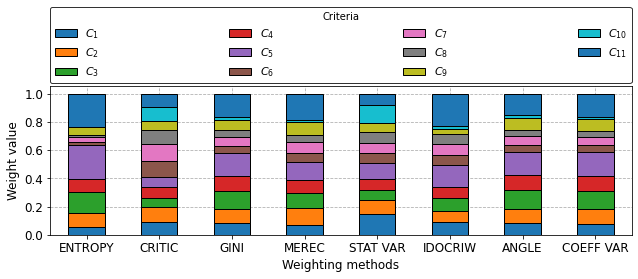
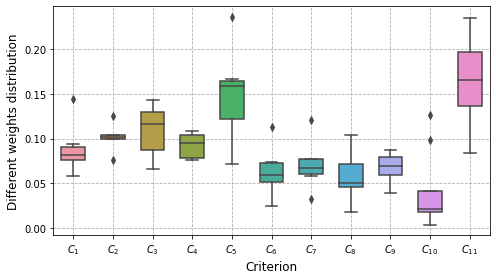
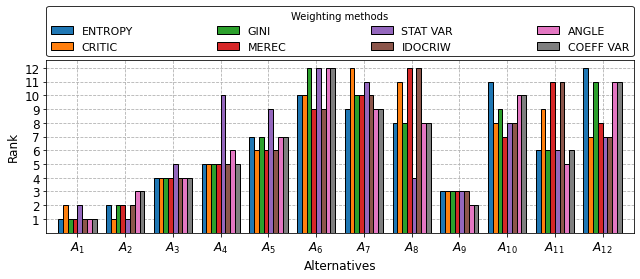
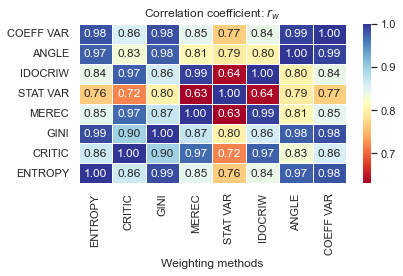
Visualize the results as column graphs of weights, rankings, and correlations.
[15]:
plot_barplot(df_weights, 'Weighting methods', 'Weight value', 'Criteria')
The PostScript backend does not support transparency; partially transparent artists will be rendered opaque.
[16]:
plot_boxplot(df_weights.T)
[17]:
plot_barplot(df_rankings, 'Alternatives', 'Rank', 'Weighting methods')
The PostScript backend does not support transparency; partially transparent artists will be rendered opaque.
[18]:
results = copy.deepcopy(df_rankings)
method_types = list(results.columns)
dict_new_heatmap_rw = Create_dictionary()

for el in method_types:
    dict_new_heatmap_rw.add(el, [])

# heatmaps for correlations coefficients
for i, j in [(i, j) for i in method_types[::-1] for j in method_types]:
    dict_new_heatmap_rw[j].append(corrs.weighted_spearman(results[i], results[j]))

df_new_heatmap_rw = pd.DataFrame(dict_new_heatmap_rw, index = method_types[::-1])
df_new_heatmap_rw.columns = method_types

# correlation matrix with rw coefficient
draw_heatmap(df_new_heatmap_rw, r'$r_w$')
Stochastic Multicriteria Acceptability Analysis Method (SMAA)
[19]:
cols_ai = [str(el) for el in range(1, matrix.shape[0] + 1)]
[20]:
# criteria number
n = matrix.shape[1]
# number of SMAA iterations
iterations = 10000
[21]:
# create the VIKOR_SMAA method object
vikor_smaa = VIKOR_SMAA()
# generate multiple weight vectors in matrix
weight_vectors = vikor_smaa._generate_weights(n, iterations)
[22]:
# Calculate the rank acceptability index, central weight vector and final ranking
rank_acceptability_index, central_weight_vector, rank_scores = vikor_smaa(matrix, weight_vectors, types)
[23]:
acc_in_df = pd.DataFrame(rank_acceptability_index, index = list_alt_names, columns = cols_ai)
acc_in_df.to_csv('results_smaa/ai.csv')
Rank acceptability indexes
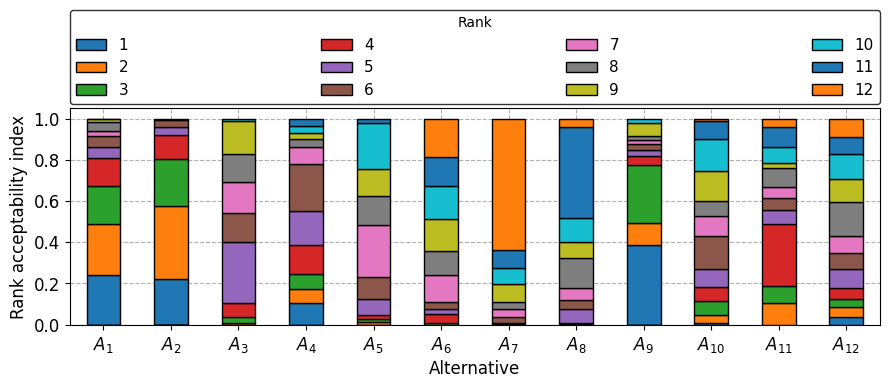
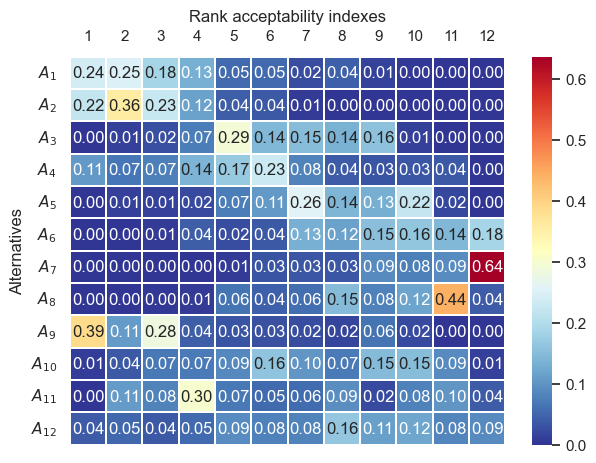
This is dataframe with rank acceptability indexes for each alternative in relation to ranks. Rank acceptability index shows the share of different scores placing an alternative in a given rank.
[24]:
acc_in_df
[24]:
| 1 | 2 | 3 | 4 | 5 | 6 | 7 | 8 | 9 | 10 | 11 | 12 | |
|---|---|---|---|---|---|---|---|---|---|---|---|---|
| $A_{1}$ | 0.2395 | 0.2499 | 0.1847 | 0.1341 | 0.0540 | 0.0532 | 0.0240 | 0.0441 | 0.0128 | 0.0037 | 0.0000 | 0.0000 |
| $A_{2}$ | 0.2207 | 0.3576 | 0.2252 | 0.1155 | 0.0405 | 0.0351 | 0.0054 | 0.0000 | 0.0000 | 0.0000 | 0.0000 | 0.0000 |
| $A_{3}$ | 0.0002 | 0.0102 | 0.0249 | 0.0723 | 0.2924 | 0.1429 | 0.1516 | 0.1359 | 0.1589 | 0.0107 | 0.0000 | 0.0000 |
| $A_{4}$ | 0.1063 | 0.0660 | 0.0749 | 0.1386 | 0.1666 | 0.2296 | 0.0797 | 0.0375 | 0.0303 | 0.0348 | 0.0357 | 0.0000 |
| $A_{5}$ | 0.0005 | 0.0117 | 0.0142 | 0.0218 | 0.0743 | 0.1069 | 0.2564 | 0.1403 | 0.1311 | 0.2230 | 0.0198 | 0.0000 |
| $A_{6}$ | 0.0000 | 0.0009 | 0.0074 | 0.0419 | 0.0242 | 0.0364 | 0.1318 | 0.1158 | 0.1524 | 0.1630 | 0.1418 | 0.1844 |
| $A_{7}$ | 0.0000 | 0.0000 | 0.0007 | 0.0013 | 0.0061 | 0.0314 | 0.0344 | 0.0342 | 0.0888 | 0.0766 | 0.0900 | 0.6365 |
| $A_{8}$ | 0.0000 | 0.0024 | 0.0025 | 0.0055 | 0.0643 | 0.0438 | 0.0574 | 0.1469 | 0.0771 | 0.1191 | 0.4416 | 0.0394 |
| $A_{9}$ | 0.3859 | 0.1073 | 0.2818 | 0.0416 | 0.0312 | 0.0284 | 0.0224 | 0.0168 | 0.0644 | 0.0202 | 0.0000 | 0.0000 |
| $A_{10}$ | 0.0095 | 0.0357 | 0.0681 | 0.0707 | 0.0858 | 0.1597 | 0.0998 | 0.0698 | 0.1491 | 0.1512 | 0.0889 | 0.0117 |
| $A_{11}$ | 0.0000 | 0.1077 | 0.0799 | 0.3025 | 0.0688 | 0.0538 | 0.0553 | 0.0942 | 0.0214 | 0.0773 | 0.1001 | 0.0390 |
| $A_{12}$ | 0.0374 | 0.0506 | 0.0357 | 0.0542 | 0.0918 | 0.0788 | 0.0818 | 0.1645 | 0.1137 | 0.1204 | 0.0821 | 0.0890 |
Rank acceptability indexes displayed in the form of stacked bar chart.
[25]:
matplotlib.rcdefaults()
plot_barplot(acc_in_df, 'Alternative', 'Rank acceptability index', 'Rank')
The PostScript backend does not support transparency; partially transparent artists will be rendered opaque.
Rank acceptability indexes displayed in the form of heatmap
[26]:
draw_heatmap_smaa(acc_in_df, 'Rank acceptability indexes')
Central weight vector
The central weight vector describes the preferences of a typical decision-maker, supporting this alternative with the assumed preference model. It allows the decision-maker to see what criteria preferences result in the best evaluation of given alternatives. Rows containing only zeroes mean that a given alternative never becomes a leader.
[27]:
central_weights_df = pd.DataFrame(central_weight_vector, index = list_alt_names, columns = cols)
central_weights_df.to_csv('results_smaa/cw.csv')
[28]:
central_weights_df
[28]:
| $C_{1}$ | $C_{2}$ | $C_{3}$ | $C_{4}$ | $C_{5}$ | $C_{6}$ | $C_{7}$ | $C_{8}$ | $C_{9}$ | $C_{10}$ | $C_{11}$ | |
|---|---|---|---|---|---|---|---|---|---|---|---|
| $A_{1}$ | 0.085557 | 0.068852 | 0.163567 | 0.127721 | 0.120978 | 0.074311 | 0.073052 | 0.079822 | 0.055629 | 0.053372 | 0.097139 |
| $A_{2}$ | 0.119505 | 0.091197 | 0.076790 | 0.123850 | 0.056169 | 0.080498 | 0.080611 | 0.079016 | 0.071870 | 0.109797 | 0.110698 |
| $A_{3}$ | 0.025481 | 0.024065 | 0.193722 | 0.116842 | 0.152955 | 0.039404 | 0.032034 | 0.020895 | 0.005310 | 0.268307 | 0.120985 |
| $A_{4}$ | 0.043895 | 0.085792 | 0.066643 | 0.056497 | 0.065895 | 0.084770 | 0.092258 | 0.084303 | 0.081521 | 0.206366 | 0.132060 |
| $A_{5}$ | 0.041701 | 0.283298 | 0.035020 | 0.057731 | 0.051069 | 0.046757 | 0.037362 | 0.032076 | 0.100242 | 0.243114 | 0.071629 |
| $A_{6}$ | 0.000000 | 0.000000 | 0.000000 | 0.000000 | 0.000000 | 0.000000 | 0.000000 | 0.000000 | 0.000000 | 0.000000 | 0.000000 |
| $A_{7}$ | 0.000000 | 0.000000 | 0.000000 | 0.000000 | 0.000000 | 0.000000 | 0.000000 | 0.000000 | 0.000000 | 0.000000 | 0.000000 |
| $A_{8}$ | 0.000000 | 0.000000 | 0.000000 | 0.000000 | 0.000000 | 0.000000 | 0.000000 | 0.000000 | 0.000000 | 0.000000 | 0.000000 |
| $A_{9}$ | 0.096995 | 0.115952 | 0.066120 | 0.061943 | 0.105055 | 0.101578 | 0.099929 | 0.104295 | 0.132537 | 0.055860 | 0.059736 |
| $A_{10}$ | 0.056299 | 0.030817 | 0.041581 | 0.150271 | 0.045265 | 0.087209 | 0.107615 | 0.080866 | 0.073499 | 0.227022 | 0.099554 |
| $A_{11}$ | 0.000000 | 0.000000 | 0.000000 | 0.000000 | 0.000000 | 0.000000 | 0.000000 | 0.000000 | 0.000000 | 0.000000 | 0.000000 |
| $A_{12}$ | 0.074129 | 0.038418 | 0.044376 | 0.044803 | 0.044055 | 0.147604 | 0.169826 | 0.132190 | 0.038341 | 0.144566 | 0.121692 |
Rank scores
[29]:
rank_scores_df = pd.DataFrame(rank_scores, index = list_alt_names, columns = ['Rank'])
rank_scores_df.to_csv('results_smaa/fr.csv')
[30]:
rank_scores_df
[30]:
| Rank | |
|---|---|
| $A_{1}$ | 3 |
| $A_{2}$ | 1 |
| $A_{3}$ | 6 |
| $A_{4}$ | 4 |
| $A_{5}$ | 9 |
| $A_{6}$ | 10 |
| $A_{7}$ | 12 |
| $A_{8}$ | 11 |
| $A_{9}$ | 2 |
| $A_{10}$ | 7 |
| $A_{11}$ | 5 |
| $A_{12}$ | 8 |
Subjective weighting methods
The illustrative example concerns the multi-criteria problem involving a selection of four alternative sites in Poland for wind farm location regarding ten criteria assessment. The data for this problem used in the procedure for determining the criteria weights in this example and the data on the performance of the alternatives against the evaluation criteria were acquired from the research paper https://doi.org/10.3390/su8080702
[5]:
# Load data from csv file
data = pd.read_csv('./dataset_localisations.csv', index_col='Symbol')

# decision matrix with alternatives' performance values
df_data = data.iloc[:len(data) - 1, :]

# Criteria types
types = data.iloc[len(data) - 1, :].to_numpy()

# Decision matrix in numpy.ndarray data type required by methods implemented in crispyn package
matrix = df_data.to_numpy()

# Column names
cols = [r'$C_{' + str(j) + '}$' for j in range(1, matrix.shape[1] + 1)]

# Dataframe for weight values determined by different weighting methods
df_weights = pd.DataFrame(index = cols)
[6]:
df_data
[6]:
| C1 | C2 | C3 | C4 | C5 | C6 | C7 | C8 | C9 | C10 | |
|---|---|---|---|---|---|---|---|---|---|---|
| Symbol | ||||||||||
| A1 | 106780 | 6.75 | 2 | 220 | 6 | 1 | 52 | 455.5 | 8.9 | 36.8 |
| A2 | 86370 | 7.12 | 3 | 400 | 10 | 0 | 20 | 336.5 | 7.2 | 29.8 |
| A3 | 104850 | 6.95 | 60 | 220 | 7 | 1 | 60 | 416.0 | 8.7 | 36.2 |
| A4 | 46600 | 6.04 | 1 | 220 | 3 | 0 | 50 | 277.0 | 3.9 | 16.0 |
AHP weighting method
Construct matrix with criteria pairwise comparison as numpy.ndarray type
[7]:
PCcriteria_ahp = np.array([
    [1, 2, 2, 2, 6, 2, 1, 1, 1/2, 1/2],
    [1/2, 1, 1, 1, 4, 1, 1, 1, 1/2, 1/2],
    [1/2, 1, 1, 1, 3, 1, 1/2, 1/2, 1/3, 1/3],
    [1/2, 1, 1, 1, 3, 1, 1/2, 1/2, 1/3, 1/3],
    [1/6, 1/4, 1/3, 1/3, 1, 1/3, 1/5, 1/5, 1/9, 1/9],
    [1/2, 1, 1, 1, 3, 1, 1/2, 1/2, 1/3, 1/3],
    [1, 1, 2, 2, 5, 2, 1, 1, 1/2, 1/2],
    [1, 1, 2, 2, 5, 2, 1, 1, 1/2, 1/2],
    [2, 2, 3, 3, 9, 3, 2, 2, 1, 1],
    [2, 2, 3, 3, 9, 3, 2, 2, 1, 1]
])
Calculate AHP weights
[8]:
# Initialize the `AHP_WEIGHTING` method object
ahp_weighting = mcda_weights.AHP_WEIGHTING()

# Calculate AHP weights passing matrix with criteria pairwise comparison and method of priority vector calculation
weights_ahp = ahp_weighting(X = PCcriteria_ahp, compute_priority_vector_method=ahp_weighting._eigenvector)

# save calculated AHP weights in dataframe for weights
df_weights['AHP'] = weights_ahp
Inconsistency index: 0.006188266444440638
[9]:
weights_ahp
[9]:
array([0.11649504, 0.08039711, 0.0614321 , 0.0614321 , 0.02051697,
       0.0614321 , 0.10648668, 0.10648668, 0.1926606 , 0.1926606 ])
SWARA weighting method
Provide vector criteria_indexes (numpy.ndarray type) with indexes of criteria in accordance with given decision problem from \(C_1\) to \(C_n\) ordered in descending order beginning from the most important criterion and vector s including values representing how much criterion (j-1) is more significant than criterion j in percentage in range from 0 to 1
[10]:
# criteria ordered in descending order from the most significant
criteria_indexes = np.array([8, 9, 0, 6, 7, 1, 2, 3, 5, 4])
# vector s
s = np.array([0, 0.4, 0.17, 0, 0.2, 0.25, 0, 0, 0.67])

# Calculate SWARA weights
weights_swara = mcda_weights.swara_weighting(criteria_indexes, s)

# save calculated AHP weights in dataframe for weights
df_weights['SWARA'] = weights_swara
LBWA weighting method
Construct list with lists (subsets) criteria_indexes of grouped and ordered index of criteria according to their significance beginning from the most important within each subset and list with lists containing influence values of criteria within each subset provided in order beginning from the most significant criteria_values_I. Then calculate LBWA weights using lbwa_weighting function.
[11]:
criteria_indexes = [
    [8, 9, 0],
    [6, 7, 1],
    [2, 3, 5],
    [],
    [],
    [],
    [],
    [],
    [],
    [4]
]

criteria_values_I = [
    [0, 0, 2],
    [1, 1, 2],
    [1, 1, 1],
    [],
    [],
    [],
    [],
    [],
    [],
    [3]
]

weights_lbwa = mcda_weights.lbwa_weighting(criteria_indexes, criteria_values_I)

df_weights['LBWA'] = weights_lbwa
SAPEVO weighting method
Construct matrix with degrees of pairwise criteria comparison in scale from -3 to 3, then calculate criteria weights using sapevo_weighting function.
[12]:
PCcriteria_sapevo = np.array([
    [ 0, 1, 1, 1, 2, 1, 0, 0, -1, -1],
    [-1, 0, 0, 0, 1, 0, 0, 0, -1, -1],
    [-1, 0, 0, 0, 1, 0, -1, -1, -1, -1],
    [-1, 0, 0, 0, 1, 0, -1, -1, -1, -1],
    [-2, -1, -1, -1, 0, -1, -2, -2, -3, -3],
    [-1, 0, 0, 0, 1, 0, -1, -1, -1, -1],
    [ 0, 0, 1, 1, 2, 1, 0, 0, -1, -1],
    [ 0, 0, 1, 1, 2, 1, 0, 0, -1, -1],
    [ 1, 1, 1, 1, 3, 1, 1, 1, 0, 0],
    [ 1, 1, 1, 1, 3, 1, 1, 1, 0, 0]
])

weights_sapevo = mcda_weights.sapevo_weighting(PCcriteria_sapevo)

df_weights['SAPEVO'] = weights_sapevo
[13]:
df_weights
[13]:
| AHP | SWARA | LBWA | SAPEVO | |
|---|---|---|---|---|
| $C_{1}$ | 0.116495 | 0.120886 | 0.134093 | 0.12500 |
| $C_{2}$ | 0.080397 | 0.086101 | 0.080456 | 0.08750 |
| $C_{3}$ | 0.061432 | 0.068881 | 0.061889 | 0.07500 |
| $C_{4}$ | 0.061432 | 0.068881 | 0.061889 | 0.07500 |
| $C_{5}$ | 0.020517 | 0.041246 | 0.018711 | 0.00000 |
| $C_{6}$ | 0.061432 | 0.068881 | 0.061889 | 0.07500 |
| $C_{7}$ | 0.106487 | 0.103321 | 0.089396 | 0.11875 |
| $C_{8}$ | 0.106487 | 0.103321 | 0.089396 | 0.11875 |
| $C_{9}$ | 0.192661 | 0.169240 | 0.201140 | 0.16250 |
| $C_{10}$ | 0.192661 | 0.169240 | 0.201140 | 0.16250 |
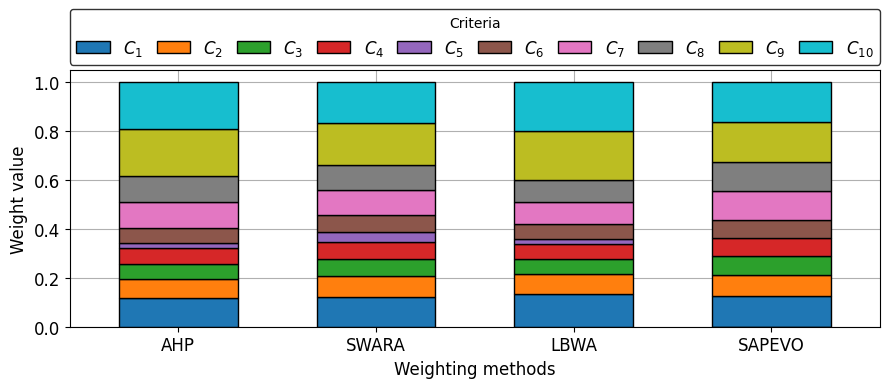
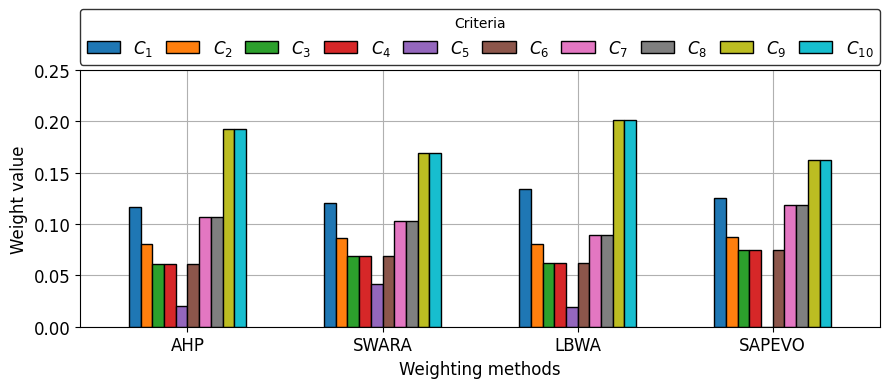
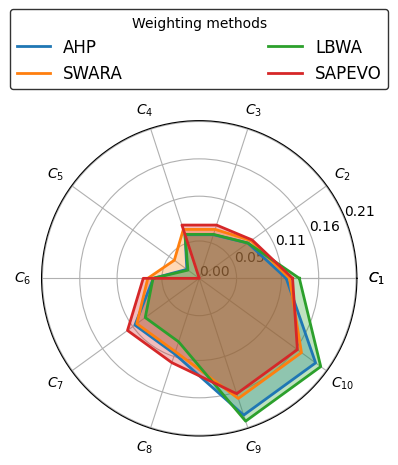
Visualize criteria weights calculated with each subjective weighting method in column charts and radar chart.
[14]:
plot_barplot_stacked(df_weights.T, stacked = True)
[15]:
plot_barplot_stacked(df_weights.T, stacked = False)
[16]:
plot_radar_weights(df_weights)
Determine utility function values using the VIKOR method and rank alternatives to generate rankings for each weighting method.
[17]:
weighting_methods_names = ['AHP', 'SWARA', 'LBWA', 'SAPEVO']
weights_list = [weights_ahp, weights_swara, weights_lbwa, weights_sapevo]

# MCDA assessment
# dataframe for alternatives
alts = [r'$A_{' + str(j) + '}$' for j in range(1, matrix.shape[0] + 1)]
df_prefs = pd.DataFrame(index = alts)
df_ranks = pd.DataFrame(index = alts)

vikor = VIKOR()
for el, weights in enumerate(weights_list):
    pref = vikor(matrix, weights, types)
    rank = rank_preferences(pref, reverse=False)

    df_prefs[weighting_methods_names[el]] = pref
    df_ranks[weighting_methods_names[el]] = rank
[18]:
df_prefs
[18]:
| AHP | SWARA | LBWA | SAPEVO | |
|---|---|---|---|---|
| $A_{1}$ | 0.971262 | 0.922828 | 0.863588 | 0.962927 |
| $A_{2}$ | 0.000000 | 0.000000 | 0.000000 | 0.000000 |
| $A_{3}$ | 0.941176 | 0.941176 | 0.861822 | 0.925714 |
| $A_{4}$ | 0.954106 | 0.882663 | 1.000000 | 0.937836 |
[19]:
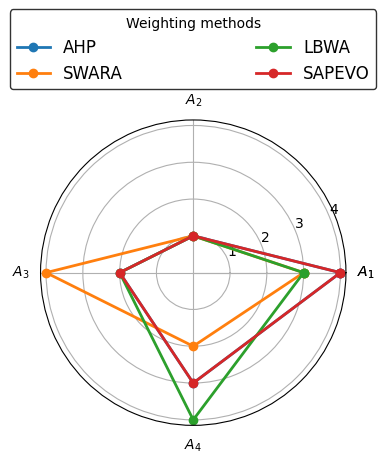
df_ranks
[19]:
| AHP | SWARA | LBWA | SAPEVO | |
|---|---|---|---|---|
| $A_{1}$ | 4 | 3 | 3 | 4 |
| $A_{2}$ | 1 | 1 | 1 | 1 |
| $A_{3}$ | 2 | 4 | 2 | 2 |
| $A_{4}$ | 3 | 2 | 4 | 3 |
[20]:
plot_radar(df_ranks)
[ ]: